Baddi is a formulation cluster because of a tax decision, not a geographical or technical one. In 2003 the central government gave new industrial units in Himachal Pradesh a ten-year exemption from central excise duty and a five-year income tax holiday, and manufacturers moved up from Punjab and Haryana to claim it. Those incentives have almost entirely run out. What is left is a dense supply base, a large number of plants of very uneven quality, and a buyer’s problem: the postcode no longer tells you anything.
What the 2003 package actually gave
The special industrial package covered Himachal Pradesh alongside Uttarakhand, Jammu and Kashmir and the North East. For a new unit it meant ten years free of central excise duty and five years free of income tax, on top of state-level subsidies and cheaper power.
The excise clock ran from each unit’s own start of commercial production rather than from a common date, which is why the belt did not lose the benefit all at once. Reporting from 2013 put roughly 250 pharma SMEs in the Baddi–Barotiwala–Nalagarh region — 75 to 80 per cent of the pharma units there — facing expiry between 2014 and 2016. The income tax holiday was curtailed earlier, in 2010.
The predicted consequence arrived. Contract manufacturers without their own marketed products, which had been built on a cost advantage rather than a customer base, went looking for buyers or joint ventures. Over-capacity and thin margins became the region’s normal condition, and they still are.
What replaced the exemption
When GST came in on 1 July 2017 the exemption mechanism itself disappeared. The Scheme of Budgetary Support, notified on 5 October 2017, reimburses eligible units 58 per cent of the central tax and 29 per cent of the integrated tax paid in cash, for what the scheme calls the “residual period” — the remainder of the original ten years from the unit’s start of commercial production.
The date to note is in the scheme itself: “The overall scheme shall be valid upto 30.06.2027.” After that there is no tax reason to make tablets in Baddi rather than anywhere else in India. Any plant that still depends on the residual subsidy for its cost position has a little under a year of it left.
Baddi’s origin story, in dates
| When | What changed |
| 2003 | Central industrial package: ten-year central excise exemption and five-year income tax holiday for new units in Himachal Pradesh |
| 2010 | Income tax holiday curtailed; units established by then retained benefits into the following decade |
| 2014–2016 | Excise exemption expires unit by unit for the bulk of BBN’s pharma SMEs; consolidation and distress sales follow |
| 1 July 2017 | GST replaces central excise; the exemption route ends |
| 5 Oct 2017 | Scheme of Budgetary Support notified — 58% of CGST and 29% of IGST reimbursed for the residual period only |
| 28 June 2024 | Revised Schedule M becomes applicable to manufacturers above Rs 250 crore turnover |
| 11 Feb 2025 | G.S.R. 127(E) gives smaller manufacturers who applied in time until 31 December 2025 to comply |
| 31 Dec 2025 | That extension expires |
| 30 June 2027 | Scheme of Budgetary Support ends |
What actually remains
The cluster effect. The Tribune reported in 2025 that the belt holds more than 350 manufacturing units, of which around 150 carry FDA approvals, and that Himachal Pradesh exported pharmaceutical products worth about Rs 10,000 crore in 2023.
For a buyer, density is the real asset. Blister foil, alu-alu foil, cartons, printed inserts, shippers, engineering spares, qualified maintenance contractors and analytical laboratories are all within an hour’s drive. A packing change that would take a fortnight to source elsewhere takes days. Recruitment of production and QA staff draws on a pool that has worked in the same industry in the same valley. None of this is a quality claim. It is a lead-time and cost-of-change claim, and it is the one that survives the end of the tax holiday.
The uncomfortable part
Concentration cuts both ways, and the enforcement record is public. In the November 2025 monthly drug alert, 49 of 205 samples declared Not of Standard Quality nationally — 23.09 per cent — were traced to units in Himachal Pradesh, across Baddi, Barotiwala, Nalagarh, Solan, Kala Amb, Paonta Sahib and Una. The state drugs controller issued show-cause notices, ordered batch recalls and began risk-based inspections of the deficient units.
That is a state-level statistic, not a verdict on any individual plant, and it is exactly why a buyer should stop treating “Baddi” as a credential. Nationally, CDSCO and state drug controllers inspected 400 premises on a risk basis and took more than 300 actions — show-cause notices, stop-production orders, licence suspensions and cancellations. India is also not a member of the Pharmaceutical Inspection Co-operation Scheme, and CDSCO does not appear on the PIC/S list of applicants as of September 2026, so there is no mutual-recognition shortcut that lets you skip your own assessment.
What to judge a Baddi plant on
Ask about the plant, not the region.
Which Schedule M cohort it was in, and what it did. Revised Schedule M applied to manufacturers above Rs 250 crore turnover from June 2024. Smaller manufacturers had to apply for an extension under G.S.R. 127(E) and comply by 31 December 2025. Ask which category the plant fell into, whether it applied, and what was physically upgraded — not whether it “complies”.
The certificate scope, not the certificate. A WHO-GMP certificate covers specified sections of a site. Confirm that the section making your dosage form is named on it, and ask for the date of the last joint inspection.
Its own quality record, in writing. Ask directly whether any of the plant’s products have been declared Not of Standard Quality, what the investigation concluded and what changed. A manufacturer that cannot discuss this calmly is telling you something.
Whether it makes for itself or for others. A pure contract manufacturer, a brand owner and an exporter have different incentives around batch size, changeover and documentation. None is wrong; they are not interchangeable.
Stability data for your climatic zone and your pack. Baddi’s own climate is irrelevant to a shipment landing in Lagos or Chattogram. Ask for 30°C/75% RH data on the exact pack.
How Salus approaches this
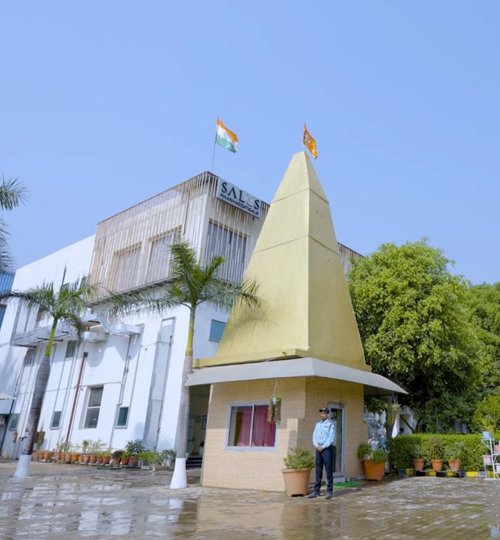
Salus Pharmaceuticals has manufactured formulations in Baddi since 2005 at a WHO-GMP and ISO 9001:2015 certified facility, with over 200 staff, 21-plus therapeutic categories, and tablets, capsules and oncology formulations packed in blister, alu-alu and aluminium formats. Buyers assessing the plant are shown the site, the certificate scope and the documentation system rather than a presentation about the region.
Leave a Reply