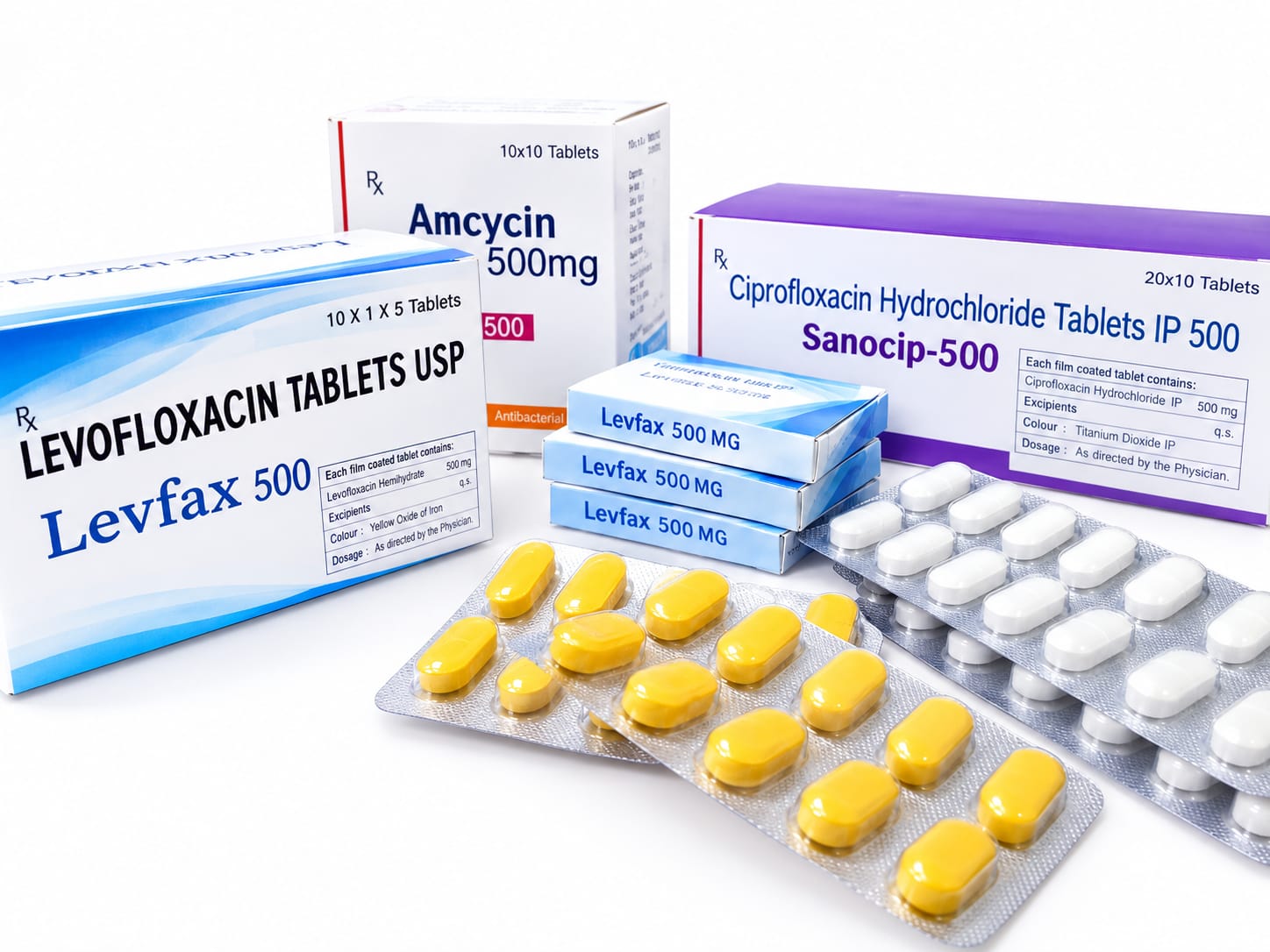
Buying antibiotics now means buying into a stewardship position, whether you intended to or not. Three things about a supplier decide whether your order helps or hurts the resistance picture in your market: which WHO aware group the range sits in, whether every pack can be traced back to a batch and an investigation, and whether the pack size matches the treatment course your prescribers actually use. None of those is a price question, and all three are answerable before you place an order.
The resistance data has moved, and it has moved against import markets
WHO’s global antibiotic resistance surveillance report, published in October 2025, found that one in six laboratory-confirmed bacterial infections worldwide was resistant to antibiotic treatment in 2023. Resistance rose in more than 40 per cent of the pathogen–antibiotic combinations monitored between 2018 and 2023, at an average of 5 to 15 per cent a year.
The regional split is the part that matters to a procurement officer in South Asia or West Africa. In the South-East Asia and Eastern Mediterranean regions, one in three infections was resistant. In the African region, one in five. More than 40 per cent of E. coli and over 55 per cent of K. pneumoniae globally are now resistant to third-generation cephalosporins, and in the African region that figure exceeds 70 per cent. Carbapenem resistance, WHO notes, was once rare and is becoming more frequent.
The mortality forecast points the same way. The Global Research on Antimicrobial Resistance study published in The Lancet in 2024 estimated 1.14 million deaths directly attributable to bacterial AMR in 2021 and 4.71 million associated with it, rising to a projected 1.91 million attributable deaths a year by 2050. Cumulatively, the study forecasts 39 million deaths directly due to AMR between 2025 and 2050, of which 11.8 million are forecast in South Asia — the highest regional burden.
WHO also reported that 48 per cent of countries did not submit surveillance data in 2023. If your national data is thin, your tender specification is doing more work than you think it is.
AWaRe is a procurement category now, not only a clinical one
The WHO AWaRe classification sorts antibiotics into Access, Watch and Reserve groups. At the 2024 UN General Assembly high-level meeting on antimicrobial resistance, member states endorsed a target that by 2030 at least 70 per cent of global human antibiotic consumption should be Access group antibiotics. Progress is tracked annually through GLASS.
That target is a purchasing instruction as much as a prescribing one. A supplier’s range can be mapped to AWaRe in an afternoon, and the map tells you something useful: a portfolio weighted towards Watch and Reserve molecules is a portfolio that will push your national Access share in the wrong direction, regardless of how the products are prescribed. Ask for the range with the AWaRe group written against each molecule. A manufacturer who has never been asked will take a few days; one who cannot produce it at all is worth noting.
Traceability: what “batch traceable” should actually mean
India’s requirement here is narrower than most buyers assume. Under G.S.R. 823(E), notified 17 November 2022 and effective 1 August 2023, drug formulations in the top-300-brand schedule must carry a barcode or QR code encoding a unique product identification code, brand and generic name, manufacturer name and address, batch number, date of manufacture, expiry date and manufacturing licence number — printed on the primary label, or on secondary packaging where there is no room.
That rule does not cover every product, and the parallel export requirement has gone. In February 2025 the Directorate General of Foreign Trade withdrew para 2.76 of the Handbook of Procedures — the long-deferred track-and-trace system for pharmaceutical exports, including primary-level barcoding and parent-child data upload — on the basis that the health ministry’s own barcoding rules and destination-market serialisation requirements now cover the ground.
The practical consequence for an importer: do not assume an Indian-made antibiotic pack carries a serialised code. Ask what is actually printed, at which packaging level, and what the manufacturer can retrieve from a batch number alone — batch record, analytical results, deviation history, distribution list. Traceability that stops at the shipper is not traceability.
Labelling can support stewardship or quietly undermine it
India’s Schedule H1, notified as G.S.R. 588(E) on 30 August 2013 and in force from 1 March 2014, covers certain third- and fourth-generation antibiotics, anti-TB drugs and habit-forming medicines. It requires a red “Rx” symbol and a boxed warning with a red border reading, in part: “It is dangerous to take this preparation except in accordance with the medical advice. Not to be sold by retail without the prescription of a Registered Medical Practitioner.” Retailers must keep a separate register of each supply for three years.
Its measured effect is instructive. A published interrupted time series analysis of Indian sales data from 2008 to 2018 found an immediate 10 per cent reduction in the use of Schedule H1 medicines after implementation and a sustained 9 per cent trend decline — while overall antimicrobial consumption kept rising, and carbapenem use went up. Labelling changes behaviour at the margin. It does not carry a stewardship programme on its own.
Product selection matters more than label text. In August 2024 India’s health ministry prohibited 156 fixed-dose combinations, including antibiotic combinations, on the Drugs Technical Advisory Board’s advice, as irrational combinations carrying risk where safer alternatives exist. If a quotation offers you an antibiotic FDC, the first question is whether it is approved in India and in your own market — not what it costs.
Pack design is a stewardship decision
Pack size sets treatment duration in practice, because patients are told to finish the pack. A 2015 Australian analysis of common primary-care prescribing scenarios found that of 32 scenarios, ten pack sizes supplied surplus doses, eighteen supplied too few, and only four matched the guideline course. Surplus antibiotics end up in a cupboard, taken later by the patient or by somebody else, or discarded into waste water where they contribute to resistant strains.
This is one of the few stewardship levers a buyer controls directly. Specify the course, not the count, and ask the manufacturer to build the blister to it.
Six questions worth putting to an antibiotic manufacturer
| Ask | A good answer looks like | Why it matters |
| Map your antibiotic range to WHO AWaRe groups | A product list with Access / Watch / Reserve marked against each molecule | Tells you whether the order moves your national Access share towards or away from the 70% target |
| What is printed on the pack, and at which packaging level | Specific: fields encoded, primary or secondary label, whether codes are serialised | India’s barcode rule does not cover every product, and the DGFT export track-and-trace requirement was withdrawn in 2025 |
| What can you retrieve from a batch number alone | Batch record, analytical results, deviations, distribution list — with a stated turnaround | This is what a recall or a field complaint actually runs on |
| Which blister configurations can you build to a treatment course | Willingness to quote more than one configuration and a stated minimum batch size | Pack size sets duration in practice; mismatched packs create leftover antibiotics |
| Stability data at 30°C/75% RH for the exact pack offered | Pack-specific data, not product-general data | Barrier properties differ by pack; the destination climate does not care what the product can do in another one |
| Any Not of Standard Quality declaration on these products, and what changed | A direct answer, the investigation conclusion, and the corrective action | Substandard antimicrobials feed resistance directly; a supplier who deflects here will deflect later |
How Salus approaches this
Salus Pharmaceuticals manufactures at a WHO-GMP and ISO 9001:2015 certified facility in Baddi, Himachal Pradesh, operating since 2005 across 21-plus therapeutic categories, with tablets and capsules supplied in blister packs and in alu-alu. Antibiotic enquiries are answered with the molecule, strength, pack configuration and pack-specific stability position together, because those four determine whether an order is usable in the destination market.
[Download the antibiotic range sheet →]
https://www.saluspharmaceuticals.com/products.html#antibiotics
Leave a Reply