
Mehak Aggarwal and her husband are the third generation running their family’s pharmaceutical manufacturing business. Salus Pharmaceuticals operates a WHO GMP certified plant in Baddi, Himachal Pradesh, manufacturing tablets, capsules, and injections, including oncology products. A second unit, Sunvet Healthcare in Kala Amb, makes eye drops. The Baddi plant alone runs on around 300 people, 107 of them staff.
That is not a small operation. Pharma manufacturing is one of the most documented, most audited, most process heavy industries in India. Every batch has a record. Every deviation has a form.
And yet both owners were inside the plant seven days a week.
The Challenge in Pharmaceutical Manufacturing Operations
That was Mehak’s own description of her weeks. Not strategy. Not expansion. Manpower and production fires, every single day, in a business that was already third generation and already certified to global standards.
These challenges can have a direct impact on pharmaceutical manufacturing operations, especially when manpower and production activities are managed manually.
Why Data Matters in Pharmaceutical Manufacturing
Here is the uncomfortable question. If a pharma plant already generates this much data, why were two capable owners still finding problems by standing on the floor?
Because data sitting in registers and batch records is not the same as data an owner can read. Nobody had translated the plant into a form that answered the only question that matters at the top: where is today’s bottleneck?
Using production data effectively can help pharmaceutical manufacturers identify bottlenecks, monitor operations, and make faster business decisions.
The gap was never capability. Mehak and her husband run a plant that clears WHO GMP audits. The gap was that no tool existed to show them the business without them physically walking it. Someone had to sit with them, name the problem in their own language, and build the tools alongside them. That work took months, one dashboard at a time, and every dashboard removed one more reason to be on the floor.
Dashboards for Pharmaceutical Manufacturing Operations
Dashboards. Not one master dashboard, but a set of them, built together over months of working side by side, each one answering a specific operational question.
We have built together lots of dashboards which now help me identify the bottleneck in just seconds
Seconds. The thing that used to take a full day of walking the floor, asking supervisors, and cross checking registers now takes seconds from anywhere. This data-driven approach has made pharmaceutical manufacturing operations more efficient and easier to monitor.
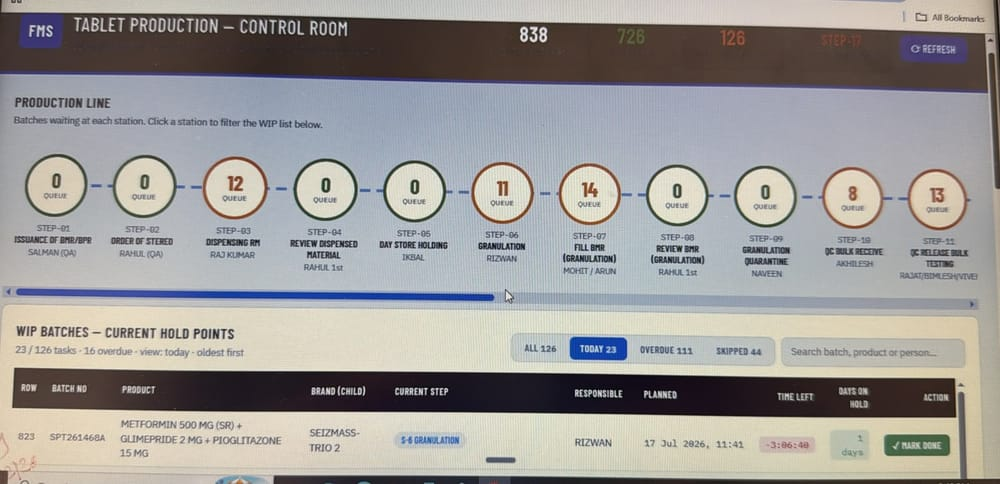
The Pharmaceutical Manufacturing Dashboard :
Here is what that changed in practice:
| Before | Now |
|---|---|
| Seven days a week inside the plant | One day a week. Monday. |
| Bottlenecks found by walking the floor | Bottlenecks identified in seconds on a dashboard |
| Chasing employees for updates | Employees run on the system, not on reminders |
| Late nights and business talk at the dinner table | Evenings, weekends, and trips are theirs again |
Results: Improving Pharmaceutical Manufacturing Operations
The numbers first. Time inside the plant dropped from seven days a week to one. Attrition dropped from 6% to 2.1%, because a team that is not being chased every day is a team that stays.
Then the compounding effect. With the plant no longer consuming every waking hour, the couple did something most manufacturers never find the bandwidth for. They wrote and launched a book, Killing Cancer: 13 Secrets of High-Stakes Pharma Manufacturing, with a media launch that got covered in more than 14 newspapers.

The Book
That is what the freed hours became. Not rest alone. Higher order work .
Leave a Reply